Organic or Paid: Where Should a Consumer App Invest First?

The first time I had to choose between organic content and paid acquisition, I treated it like choosing between two taps. Turn on paid and users arrive. Turn on organic and, with enough patience, users arrive for free.
That mental model was wrong.
Paid acquisition is closer to renting a water truck. It can deliver water quickly, exactly where you need it, but the truck is expensive. You need enough budget not only to book it, but to keep it coming long enough to learn whether the water is actually helping your business grow. Stop paying, and the supply stops.
Organic is closer to digging a well. It takes longer. The first attempts may find nothing. You need people who know where to dig, the discipline to keep going, and enough time to learn from dry holes. But when you hit the right source, you have built an asset that can keep producing without paying for every litre.
The mistake is asking which one is universally better.
Most founders use paid to avoid admitting they do not know what to say
Classic setup: a team has five positioning ideas. Instead of testing whether any of them actually resonate, they create five ads, put money behind each one and wait for Meta to tell them which mediocre message is slightly less mediocre.
The dashboard comes back clean. One ad has the best CTR, another has the lowest CAC. Everyone feels productive but forget one thing: paid can only compare the ideas you gave it. It cannot guarantee any of those ideas were good in the first place.
This is why I think many teams use paid too early. Not because paid is bad, but because it feels more respectable to have precise numbers than to admit you are still searching for the story.
Paid can tell you which message wins the test. Organic helps you discover whether the message deserves a test at all.
Organic is the brutally honest teacher your strategy needs
Organic is the teacher who does not curve the grade. The tuition is relatively cheap, the feedback is public and if your idea is boring, the market will tell you before the bell rings.
No participation trophy. If the hook does not stop people, you fail. If the story gets views but nobody wants the product, you fail differently. Either way, you learn what needs fixing.
That is exactly what makes organic useful: it does not only tell you whether a piece of creative “performed”, it exposes the reason people care.
An edtech founder came to us thinking people want to buy "a faster way to master English" but in reality, they are buying something more personal: the confidence to build a life in a new country, speak up at work, make friends, date, fall in love, or simply stop feeling like an outsider.
Same product. Completely different reasons to care.
Paid should amplify learning, not replace it
Finding a message that works does not mean organic has finished its job.
Every winner eventually gets tired.
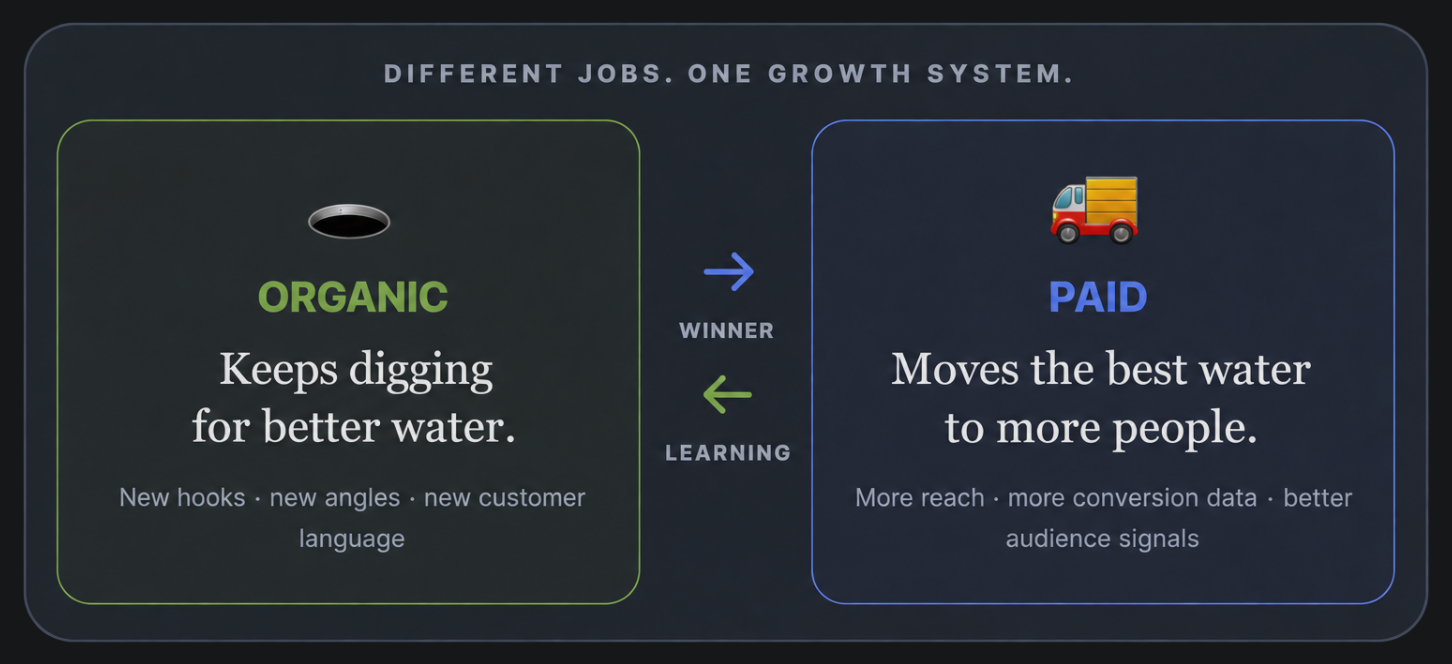
Paid amplifies the current winner. Organic looks for the next one.
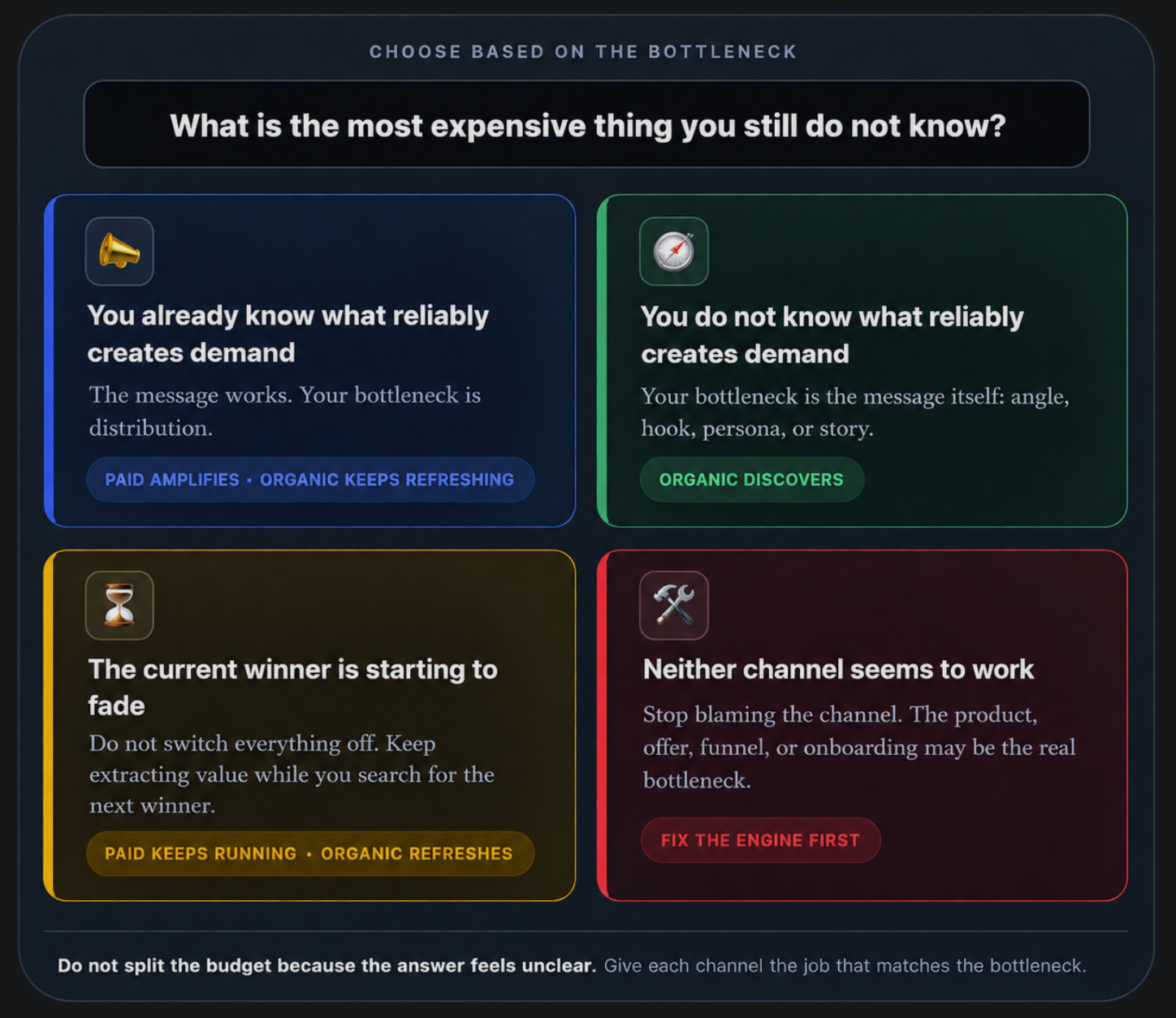
The real decision is about your current bottleneck
Once you stop treating organic and paid as rivals, the decision becomes much simpler:
So you've decided to invest in organic? Great! Now, don't make the mistakes almost everyone makes.
That is what the board below represents. It is not really a reporting dashboard. It is a decision engine.
Some hypotheses were wrong and disappeared after a few tests. Others generated attention but never translated into product interest, so we rewrote them and tried again. And occasionally, one produced both reach and genuine demand. Those were the ones that earned the right to scale.
So instead of betting on one answer, we turned each one into a series of content experiments. Every angle produced multiple hooks, every hook produced new audience feedback, and every batch of videos forced us to make a decision based on evidence rather than preference.
Those are completely different stories, even though they all lead to exactly the same product.
Was it the frustration of feeling like roommates after having kids? Was it the guilt of realizing you have not had a meaningful conversation with your partner in months? Or was it simply the curiosity of discovering questions couples never think to ask each other?
When we launched Flamme, the first app we built at Agniverse, our job was not simply to promote another relationship app. Flamme is designed to help couples cultivate their relationship through daily questions, shared rituals and small moments of intentional connection. But none of those features mattered if we could not first answer a much simpler question: what emotional story actually makes someone stop scrolling?
At Agniverse, every strategy begins with a hypothesis. Not a vague idea like “let’s post relationship content,” but something specific enough that the market can prove us wrong.
The first instinct is usually to hire creators. I think that's backwards. Creators are not where an organic strategy starts; they're where it gets executed.
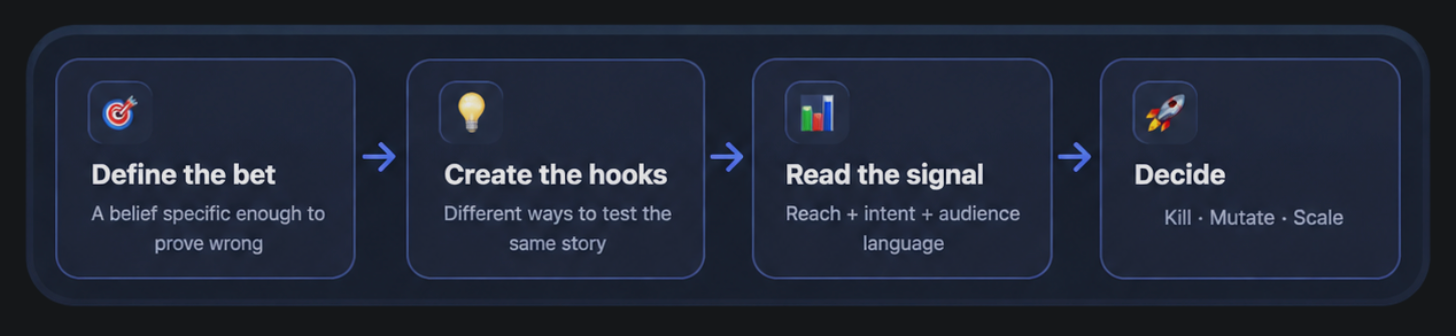
Most companies think the scarce resource is creators. We think it is judgement. Handler exists to make that judgement repeatable.
So we built Handler, the operating system we now use to manage our organic experiments. Every hypothesis, hook, creator and decision lives in one place, so the team is not just looking backwards at performance. It is deciding what deserves to happen next.
As we ran more experiments, another problem became obvious: the learning was scattered everywhere. Some of it lived in spreadsheets, some in Slack, some in people's heads. That works for a while. It does not scale.
Handler's job is simple: tell us what we should shoot next.
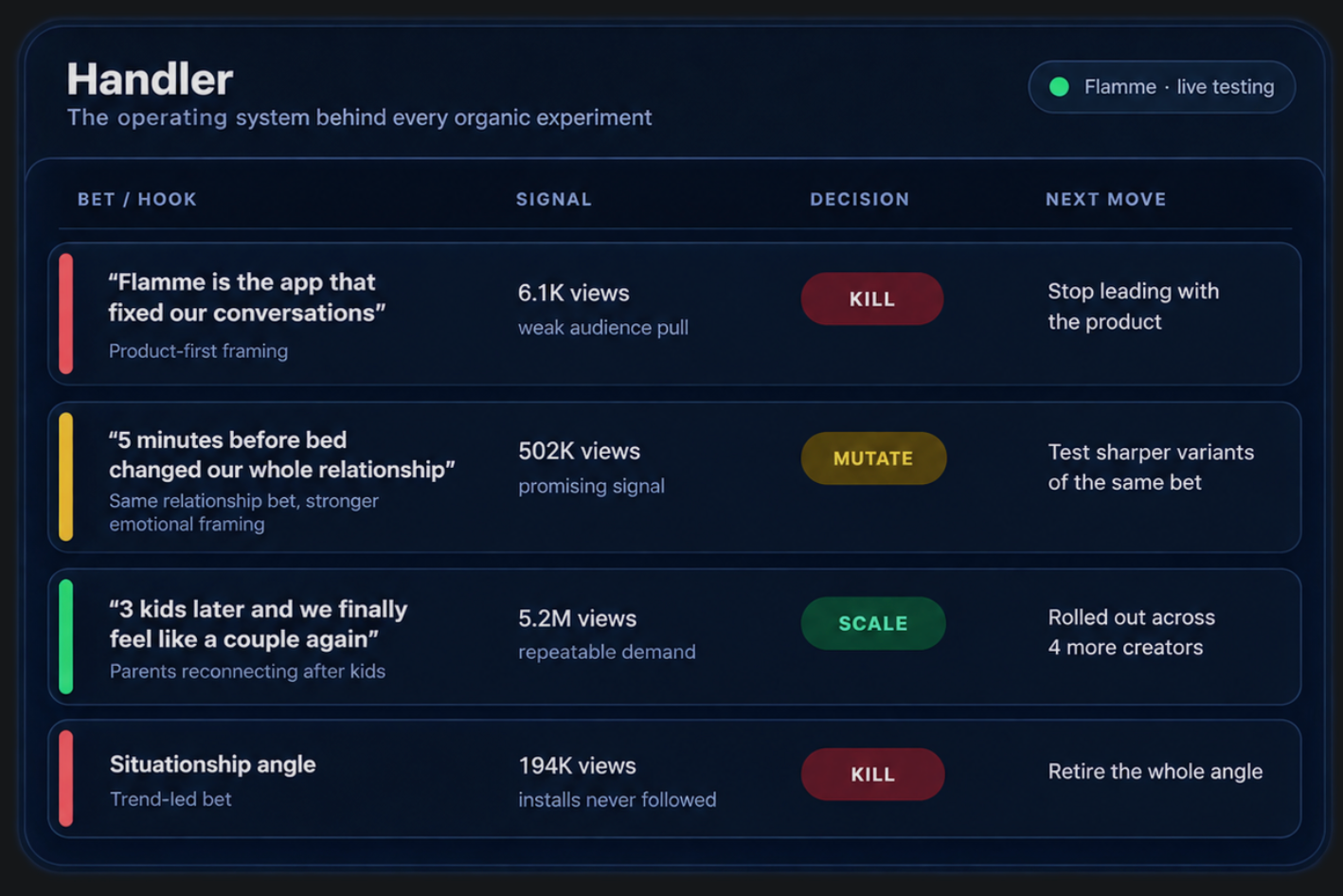
Look at what happened. The product-first hook barely moved, which made it easy to kill. The bedtime angle created enough signal to justify another version, so we kept the underlying insight and changed the execution. The parents angle hit hard enough to earn more weight, so we pushed it across more creators.
The situationship bet is my favorite example because it shows why views alone can lie. One hook reached 194K views. That sounds perfectly respectable in a Slack update. But installs did not follow, which meant the audience was entertained without becoming meaningfully interested in the product. So the whole angle died.
This is the part brands often underestimate when they say, “We can just hire creators ourselves.” Of course you can hire creators yourself. The hard part is deciding what those creators should shoot next Tuesday.
That is also why I do not think of this as content reporting. Reporting tells you what happened. A useful operating system tells you what to do next.
If there is one thing to remember, it is this👇
Organic growth is a game of patience and surgical precision. The first idea often will not work, and the second one may not either. That does not mean the channel is broken. More often, it means you have not yet found the right combination of message, format, creator and timing.
What looks like luck from the outside is usually the result of staying in the game long enough to notice patterns, being precise enough to understand why something moved, and disciplined enough not to confuse one viral post with a repeatable system. The breakout moment is visible. The hundreds of small decisions that made it possible usually are not.
So keep digging. Keep listening to what the market is telling you, and when something finally works, resist the temptation to simply celebrate it. Understand it well enough to reproduce it, then keep looking for the next source before the current one dries up.
Luck may create a spike. Precision and patience turn it into a growth system.
Need help figuring out where to dig?
If you’re trying to build an organic growth engine and want a second pair of eyes on your setup, we’re happy to spend 15 minutes looking at what you’re doing today, where the real bottleneck is, and what we’d test next.