How to choose a UGC agency for your app: 8 questions to ask before you sign
Most UGC agencies will show you a reel of videos with big view counts. Almost none will show you what those videos did to an app's retention. That gap is the whole decision.
Published 5 November 2026 · By An Nayal · 4 min read
A UGC agency for apps should be judged on the users its videos bring in and keep, not on views. Here are the eight questions I'd ask any agency before signing, including mine.
1. What happened to retention after the views?
Views are the easy part. Ask for one client where they can show the number after the spike: D7, D30, paid conversion, anything that happens inside the app.
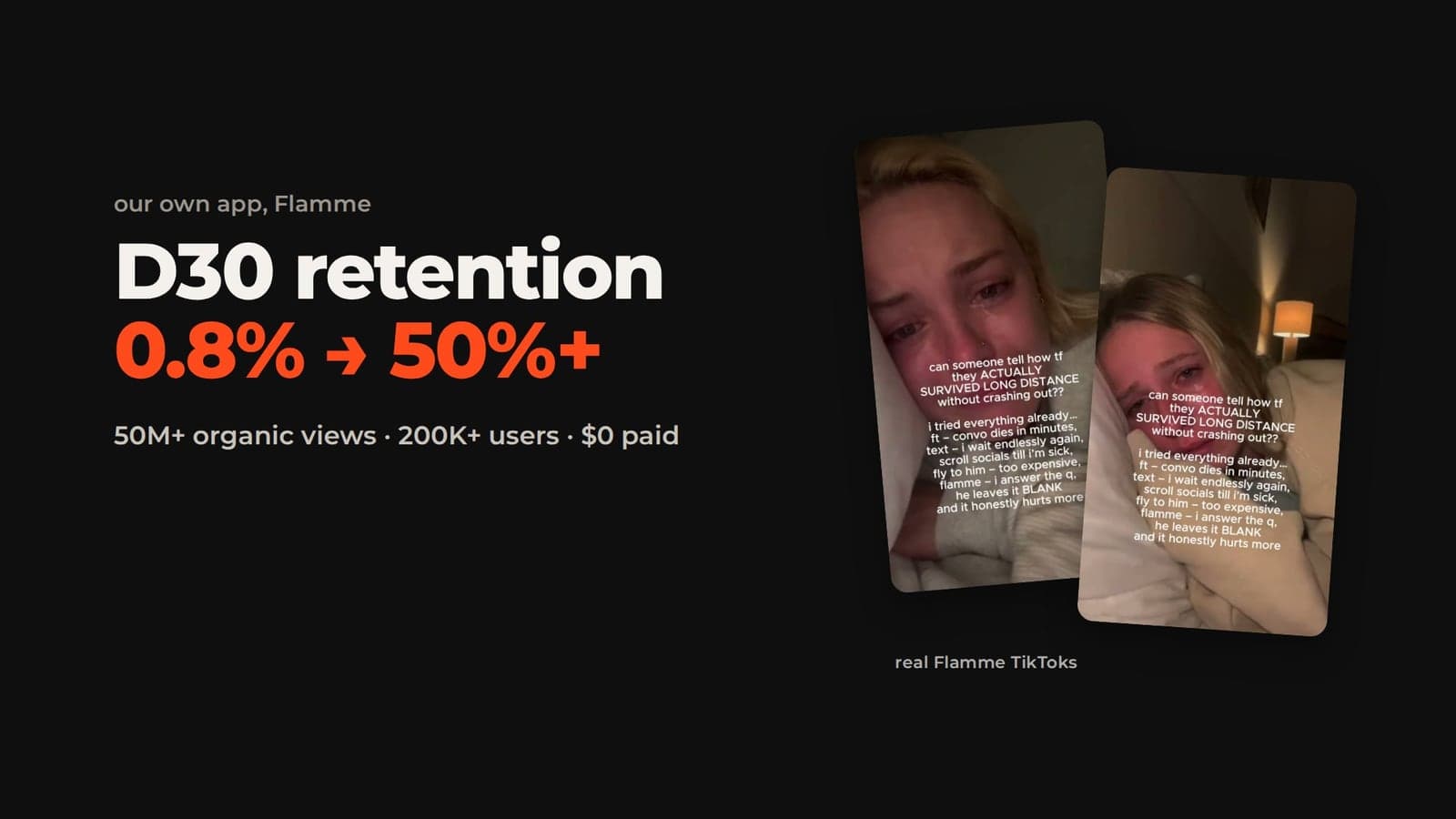
On our own app, Flamme, D30 retention went from 0.8% at the start to 4.8%, then to over 50%, while we grew it with organic UGC. That is the number we judge our work on, and it's the number you should ask every agency for.

2. Have you ever built or grown an app yourselves?
An agency that has never shipped a consumer app will learn your funnel on your money. Ask who on their side has owned an app's growth numbers, not just a client's content calendar.
3. Who actually runs my account?
Many agencies sell you the founder on the call and hand you to a junior account manager the week after. Ask for the name of the person who will write your briefs and review your numbers every week.
4. How do you brief creators?
A good brief starts from the moment your app first clicks for a user, and works back to the hook. A weak brief starts from whatever sound is trending. Ask to see a real brief, with the client name blacked out.
A good one fits on a page and has these fields:
- The app and what it does, in one line
- Goal (reach, installs or saves)
- Format and length
- Frame 1: what we see, plus the text on screen
- Beats, second by second
- On-screen text
- Sound
- CTA
- Don'ts
- Deadline, usage rights and how many hooks to film
Then look for one rule. Do they ask creators for 3 hooks? Same video, three different first frames, and all three get posted. One shoot should give you three tests, not one.
5. How many hooks and formats do you test, and how fast do you cut?
One viral video followed by six weeks of silence isn't a system. Ask how many hook angles they test in the first weeks, how often they review, and what makes them kill a format.
Then ask for their kill rule, in numbers. If they can't give you one, they're guessing with your budget. Here's ours:
- Every angle gets 3 to 5 hooks, and every hook gets tested with 5 to 10 videos.
- Under 1,000 views, we kill the hook.
- Between 1,000 and 5,000, we mutate it and test the new version.
- Above 5,000 to 10,000, we scale it.
- One day is one testing cycle.
Why 5 to 10 videos and not one? TikTok first shows a post to 200 to 300 people, so a single post can just be unlucky. An agency that judges a hook on one video is flipping a coin.
6. Organic, paid, or both?
Organic UGC means creators post on their own accounts and the algorithm decides. Paid UGC means you buy the reach. Both work. Ask which one their results came from, because a view count that was bought tells you little about the content.
7. What will you report every week?
You want views, but also the numbers after the view: clicks, installs or sign-ups, and retention where you can share it. If the weekly report stops at views, so will their attention.
8. What does it cost, and what's included?
Ask for the monthly price, how many creators and posts it covers, and who owns the content. Some agencies are cheap, some are expensive. The price only means something next to the answer to question 1.
I'm not going to sell you snake oil, and you shouldn't accept it from anyone else. An agency that can't show you a number after the views is selling you a reel.
Start this week
- Pull your D30 retention by acquisition source. If your analytics can't split it by source yet, fix that before you hire anyone, or you'll never know what the agency did.
- Write one sentence that answers "when does my app click for a new user?" Every brief an agency writes for you should start there.
- Send the eight questions above to every agency on your shortlist on the same day, and put the answers side by side.
- Ask each agency for one real brief, one weekly report and their kill rule, client name blacked out. Check the brief against the fields in question 4. The report tells you what they'll pay attention to.
What Agniverse Media is
Agniverse Media is UGC management for consumer apps, run by An Nayal and Lauriane Nayal, the operators who built Flamme, grew it to 50M+ organic views and 200K+ users on $0 paid, and sold it to Arya.
Results for other apps (client names stay private):
- Health app: 9M organic views, D30 retention up 9 points
- Travel app: 22M organic views
- Edtech app, pre-launch: 3M views and 20K pre-registrations before it went live
Frequently asked questions
What is a UGC agency for apps?
An agency that finds creators, briefs them and runs short-form videos (mostly TikTok, then Instagram, YouTube and Facebook) to bring users to an app.
How do I compare UGC agencies?
Ask each one for a retention or conversion number from a real client, not only views. Then compare who runs the account, how they brief, and what they report weekly.
What does a UGC agency for apps cost?
It varies widely with scope. We share pricing on a short call, once we know it's a fit.
Is UGC worth it for a small app?
It can be. Flamme grew to 200K+ users with $0 on paid ads. But if your app doesn't keep users yet, fix that first. UGC brings people in, it can't make them stay.
Want this run for your app?
Agniverse Media runs organic UGC for consumer apps, optimized for conversions first, then retention.